
|
|
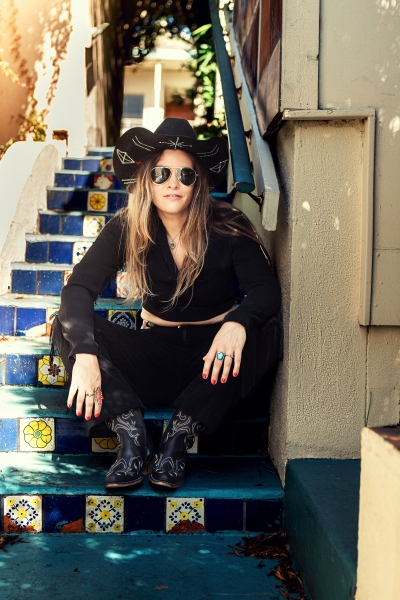
Ruby Dice - Fun Country Music From Austin |
|
Perhaps the best
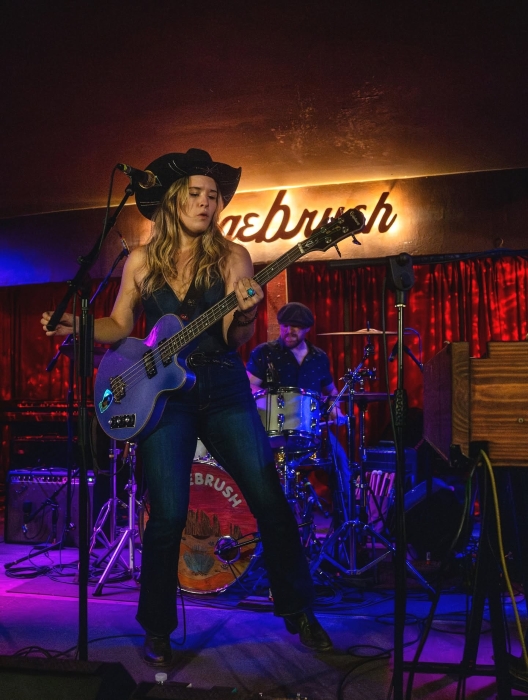
way to introduce you to singer, songwriter and electric bass guitar
player Ruby Dice from Austin, Texas via Gunnison, Colorado where she
grew up, is to let you take a peek at
a trailer
to a documentary that she and her bandmates made while creating
her just released album Take Me Back.
The songs are relatable whether you are in the music community,
the store clerk stocking shelves or the guy or woman driving a truck.
These songs are about real life, but they are not tragic, they are fun
and entertaining, as well as well-written, played and engineered.
Describing this as intentional, Ruby Dice says, “I almost have my next
record written and a lot of the songs are about working (big smile). We
were always stocking shelves from a pretty young age at the hardware
store, but when I was eleven, I was cleaning bathrooms. (With a serious
look she continues) Hardware bathrooms are kind of gross. I try to write
about what I know about. I have worked a lot in my life. (Many) of my
classmates were out taking care of animals, out in the cold when they
were little kids. It is a relatable topic and I try to write about what
I know. “
As you might suspect from the trailer to the documentary, the album
represents a collaboration with some of Austin’s finest musicians.
She expands upon that thought, “I really wanted to highlight what makes
this town so special right now. I think as artists we can get caught up
in future goals and I didn’t want to do that with this album. I have
such a special team that I get to work with all of the time. I really
lucked out with all of these guests that said yes. It originally started
with me just wanting to become a better songwriter and I was going to
the BMI office twice a week and hitting up as many people as I could to
write songs with me.
For those who are familiar with New York City’s history of the Brill
Building that acted as a home for many of the iconic singer and
songwriters of Pop music, it is like Ruby Dice formed her only little
Countrified incubator right in Austin, Texas, while creating the album,
Take Me Back.
One of the local artists who appears on this record is Shiny Ribs, as he
does a duet with Ruby Dice on the song “Dress to Impress.”
“If Austin had a Dr. John he, is it. On that song he is a sassy dude. He
always has these three-piece suits on and in bright colors. He is really
an explosive entertainer on stage. I needed a prompt that was going to
match his enthusiasm and energy. We came up with “Dress to Impress,” and
he really embodies every part of his performance. I have a live video
with him up on YouTube. He was cracking me up the whole time. He was
dancing around and I could not keep up with that sass, that’s for sure,”
she says.
Continuing to explain Ruby Dice says, “Dress to Impress.” is like a
bluesy number and we threw in this little instrumental bridge that tales
a Rock and Roll twist to
it. It was a blast to record this one. It was one of my favorite ones on
the album.”
The album was recorded at Bud’s Recording Studio in Austin, Texas.
“It (the studio) reminds me of the setup of Sun Records. Andrew Trube
and Sam Patlove own that studio and it is really great. They are
definitely part of the family community here.
I did a lot of pre-production work with the band over at another studio.
I had a residency at that time at a club downtown called The White Horse
(located on Comal Street) where there are a lot of two-steppers. We were
shedding the album live to see how people reacted. It was a mixture of
demoing them and playing them live over the course of a year.
Not all of the songs got the same treatment. I had some last-minute
Country shows and we would throw in one (song) and see what happened
with it. Once we got to the studio it was two days of tracking with the
full band. It was pretty
quick. We can get most songs in three takes.
I am not a big fan of overdubbing, so I try to get that organic vibe
with the band. The goal is always I want the records to sound like we
are playing live.
It took about two days with the full band and then it was about another
week to get all of the guests in. It took that long, because we were
filming interviews between the takes. We were forming the documentary
side.”
Well Ruby Dice and her band sure got this right, because as you listen
to the album, we reckon that you will feel like you are attending one of
their gigs.
Take Me Back
also has a wonderful song called “Grey Horse,” featuring, none other
than another Austinite by the name of Grey Horse.
Grey Horse has his own band, but he is an American Native dude and he
will ride his horses (around Austin) and he has a mule that he will haul
around with him as well. He is like an entity in this city. He will
bring his horses and his mule downtown on South Congress with all of
these Beverly Hills (type) big buildings. He will actually perform from
the back of his mule. The guy who wrote those lyrics for Grey Horse to
speak is Sitting Bull’s Great-Grandson.
As we were demoing. I thought there was a personality this album was
missing. I was going through all of the people who are well-known around
this area and Grey Horse was the first one that came to mind. (I
thought) we need our horseman on this album and to pay tribute to
someone who has done a lot for people in this town. He is just a great
energy to have around in the studio.
We needed to have him on there,” she says.
The song “Little Big Town,” is both a nod to the people of Austin and
also the recognition that the landscape of the city’s music scene is
changing. Ruby Dice thinks about this part of our conversation thoughtfully, before saying, “I think it is a bit of both. It is a city that really supports each other and it is very community driven. I have been here since 2013 and I have seen some of that start to disappear, as the Nashville influence is coming into town. The Ryman bought The Moody Theater. We are seeing more of that industry come in and some of the culture of that industry as well. It’s a little less community driven. There is good and bad that comes with both.”
What is appealing about “Little Big Town,” is it comes across as more of
a conversation.
“I wanted Nakia on this album in particular, because we paid for this
album and documentary with city funds, that he helped to push through.
He used to head up ATXM, Austin Texas Musicians. It is a whole program
that works with the government to get funding for the artists. Those
kinds of grants didn’t exist when I first came here. He said hey the
city has all of these funds just sitting there, that are set aside for
artists from the hotel taxes. He went and fought hard and pushed hard
for all of us. He took time off his career to do so. Without him this
project wouldn’t have been a thing.
We wrote this one with him as well. He is fun. He is LGBTQ+ and it was a
lot of fun getting to know him through this (process).
He can really play it up theatrically when he is putting
personality into it,” she says.
We wondered what it was like for Ruby Gold to move from the small town
of Gunnison, Colorado to Austin, Texas a booming metropolis.
“My folks owned a hardware store as well (as being a minister). Growing
up I was watching my dad pray over folks in aisle Five. Coming out this
way I went from being the town bass player to here and being a very
small fish in a very big pond. I think the scariest thing about
moving out here was driving. The biggest traffic jams back home
were cows. Moving out here I was getting honked at left and right,
because I didn’t know how to merge onto a busy highway. I thought I was
going to die out there for sure. I will drive all of the cliffs out
there in Colorado, but these speeds are crazy out here.
Austin is definitely home now.
A lot of my family has moved out of Colorado. I had a sister in
Houston, before I moved to Austin. She has a grandbaby, so my parents
are out in Houston now. It is interesting going home, because it is so
expensive and so tiny. There are not really jobs there with a liveable
wage. I have gone back home and I know some of the older folks who have
stuck around, but most of my class moved out, because they couldn’t
afford to live in their own hometown. It is interesting going back home.
Oh yeah, I recognize these places, but all of the businesses have
changed,” she says.
So, Ruby is the song “Take Me Back,” does not appear to be you talking
about your hometown.
“It is something different. I read this article that the Austin
Statesman put out and it was written in the 1800s, when they changed
the name of Austin from Waterloo to Austin. That is when everybody
started to complain that (the city) was going down hill, because it was
changing too much. It was about how every year there were more people
complaining. I got such a kick out of that.
I have conversations often about how much the city has changed and how
they disapprove of the change. Most of them when I talk to them have
this idea of what it (the city) was like when they were in their
twenties. I thought what an interesting idea, it is the freest time in
your life. It has nothing to do with the city, but more to do with that
particular time in your life.
Yeah, take me back to the good old days.”
It will not come much of a surprise, growing up as the daughter of a
minister, that some of Ruby Dice’s first experiences with music began in
a worship band in her dad’s church.
“My dad wasn’t quite the head preacher
at the time. The preacher at the time took the bass and handed it
to me and he gave me the set list for the next Sunday. He said you
better learn this (she laughs softly). I definitely fumbled my
way through that set with one finger (more laughter). I think I
was fourteen when that happened,” says Ruby Dice
That, however, was not her first instrument that she ever played, as she
explains, “My whole family plays. My grandma is going to be ninety-two
this year and she still plays. It was like musical chairs, only you
would pass the instruments around. I grew up in a circle playing with
the family, ever since I can remember really. You started out with
shakers if you were little. My sister was playing bass at the time and I
was playing flute.
There was a big argument in my house (about the flute), because I wanted
to play trombone and my mom said you can’t even reach the (and she makes
the hand motions to emulate playing the trombone). I just wanted the
loud, obnoxious instrument, so she made me play flute,” she recalls.
Please visit the
Ruby Dice
website
and you can follow her and her band also
on
Instagram
here. If you would like to listen to some music Ruby Dice has posted on
YouTube this is
her
channel.
#RubyDice #AustinTexasMusic #CountryMusic #RivetingRiffs #RivetingRiffsMagazine #EntrevistaMusica
|