|
|
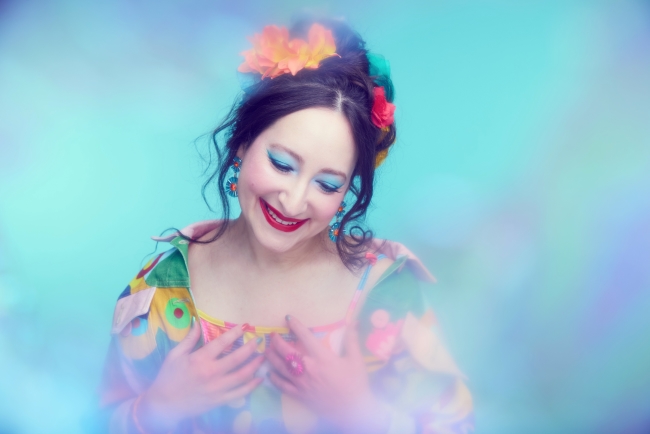
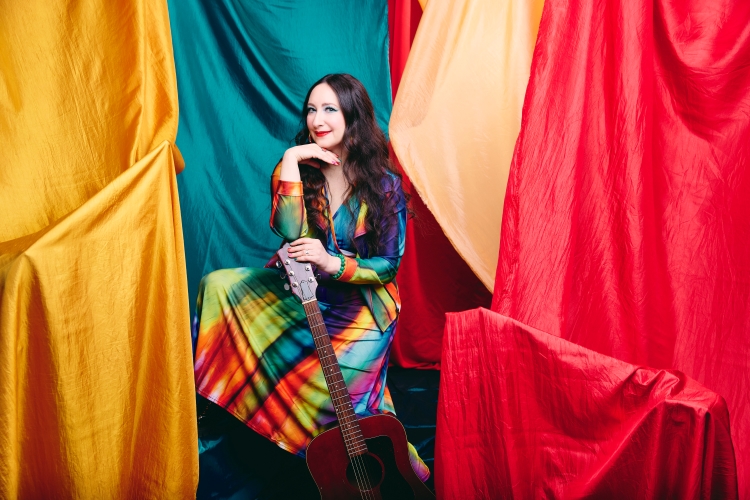
Rachael Sage and The Sequins |
|
Rachael Sage’s current album Canopy creates a welcoming vibe for
the listener, and the singer songwriter musician has a way with her
musical canvass of creating a big tent that says come on in, everybody
is welcome. This collection of songs creates an intimate setting in
which she seems comfortable combined with an orchestral sound (more on
that later).
“That is always what we are striving for. When I hear you say that it is
almost like you might be picking up on this concerted intention to have
this be more of a band type of a project and even though I have been
playing for many years with most of the folks on this record there was
definitely something different, in knowing before I rolled my sleeves up
that I wanted this to be a Rachael Sage and the Sequins record.
I had already worked a couple of times before with my engineer
Mikhail Pivovarov.
He has been very graciously coming up to where I live in the Hudson
Valley and doing a lot of the recording with me in my actual home space.
We did maybe fifty percent of it up here and the other half with bass,
drums and piano in Connecticut at the Carriage House (Carriage House
Studios). Maybe that is what you are hearing.
I have recorded with bands frequently. I don’t always do things
separately and in piecemeal. We have gone in as a trio or even more to
record live. As a project I really wanted the sensibilities of the songs
which are about inclusivity and acceptance and safety and to use your
word with a certain degree of comfort. It comes from all of those
things, which we need in the world, and especially now. I wanted the
record and the dynamic between us as friends and peer musicians to come
through the music. I was very conscious of that and I think I was maybe
less control freakish about my pre-existing concepts and vision as a
musician. I was a little bit more open to the ideas in terms of
arrangements. I still have a very strong production sensibility, but I
wanted to make sure everybody had a chance to shine on this record,”
says Rachael Sage.
Maybe I should highlight Kelly Halloran, as she has been playing with me
for a long time. Right now, we are on a teeny, tiny hiatus. She has been
out on the road. Over the course of a year, she kept
coming back to these tunes, adding more ideas. I had her up here in
Hudson Valley and we worked together in Connecticut. Every once in a
while, I sent her tracks remotely. We usually do it in person. At this
point we complete each other’s sentences. We have done so much touring
and performing live in the U.S. and abroad. She is super easy to work
with and very generous.
My cellist that I have been playing with lately, Dave Eggar (Paul Simon,
Beyoncé) is a Grammy Award winning string arranger and just a beautiful
musician and human being. He has a heart of gold. He is very kind and
compassionate. He and I have worked on other projects like composing and
performing music with the Attack Theatre in Pittsburgh (Editor’s note
where Dave Eggar is the Musical Director). We are gearing up to work
on a Classical project. He is someone I have worked with for many years
and he has been on multiple albums. We have been playing a lot more
together live.
Between the two of them we do have an orchestra. That’s the bottom line.
We keep layering different tracks. One of my favorite things to do as a
producer is to arrange strings.
I think a lot of that (the use of strings) has to do with two things. I
was a child born in the seventies and I heard a lot of singer songwriter
music growing up that did have strings, but not on everything. When
there were strings on something it made it special. There was a certain
desire to elevate the emotion in the song. If it was Cat Stevens with
strings on a song, someone thought this could go to a whole other level
than you just playing acoustic guitar.
I heard a lot of that music from my folks. Of course, (there was)
Classical music that I heard as a ballet student and performer in New
York. I remember the very first time we performed in the Nutcracker and
we had only rehearsed it, with a studio rehearsal pianist. Then imagine
you have your final tech rehearsal at the Lincoln Center and all of a
sudden for the first time in your life you are hearing a live orchestra.
Of course, they are playing the tempos differently and it is different.
You just have to go with that energy, adapt, speed it up or slow it
down. It was very exciting and probably one of the most formative
experiences in my childhood to dance to an orchestra.”
The song “Kill
The Clock,”
is pretty darn good for being written by a teenager, which is the age
Rachael Sage was at the time. If it was a story in a book, we would say
it leaps off the page, with plenty of colorful imagery and you view the
scenes through Sage’s eyes.
She says, “It is emotionally psychedelic and that is what it is. I had a
demo of it that was collecting dust and degrading on DAT tape and
cassette that we found in my mother’s basement a couple of years ago. I
played it for Mikhail my wonderful recording engineer and longtime
co-producer. We had such a laugh over how wordy I was and how many words
per second I was spewing out. At that time in your life (as a teenager)
there is so much that you are feeling and expressing in a way that I
don’t necessarily do now. I am much more tempered and I edit myself and
I reflect more. Back then it was just like any creative, imaginative
vision that I had, I wrote it down and I thought I might turn it into a
song.
I didn’t have any rules and I didn’t know what kind of a song I was
making but looking back I could hear that I was influenced by maybe
Talking Heads. There is kind of a talk, “singy” thing and I am
describing a landscape that I was perceiving around me, in a town that I
grew up in. There was just
a lot of mindless pursuit of success (in that town), see more, be more
and do more. That was in the eighties, so as a kid I am taking this all
in and that is what a lot of the imagery is about, the rat race, and not
only for adults, but for their kids who are pushed so, so hard to
achieve and be perfect.”
Gentle lyrics and
the gentle vocals of Rachael Sage introduce the song “Just
Enough,”
“Every time you touch my hand I feel love / Every time you look in my
eyes I feel love / Every time that you touch my cheek I feel love /
Every time you give me a squeeze I feel love…”
James Mastro serves up a delicious electric guitar solo and Rob
Cutro’s Hammond B3 is exquisite (Who doesn’t like a really good
Hammond B3 player?).
“That one came pretty quickly and it is a new song. I wanted to include
a song on the album knowing that this was about inclusivity, safety,
acceptance and that kind of unconditional willingness to talk it out
instead of being divided and rejecting one another out of hand. I was at
festival called The Ladybug Music Festival that is an east
coast phenomenon. It is (hosted) by a wonderful woman and the rule of
the festival is that it is all female fronted bands. I was traveling
there with my wonderful bandmate Trina Hamlin who plays harmonica and
sings with me. We’ve been great friends for many years and we had such a
great time driving there. We were
laughing and keeping each other company. It was a delightful sunny day
and we played the show, packed up, came back and I wrote that song in
about ten minutes. It was about self-acceptance and the ability to share
generously with someone else when you feel good about yourself,” says
Rachael Sage.
Continuing she talks about those times when a song just flows through
you, without you having to think okay I need to write a song today, “It
is the best. It doesn’t happen that often, but when it does, it does
feel like you had very little to do with it. You have done your job of
being just open to receive. It is a different type of craft and skill
set as well. It is more subconscious and being in touch with your own
muse and keeping the faucet on so to speak.”
There are two versions of the song that appear on the album, the first
track introduces the song and features James Mastro’s electric guitar
emboldened by the use of a wah-wah pedal. The second version of the song
has more of a chamber feel to it.
As for the first track she says, “I don’t know if I am just a wanna’ be
Woodstock girl or what. (She chuckles) I hear wah-wah-wah and I am just
(She puts her hands in the air excitedly). I like that sound. It
is a happy sound and it has a little humor and a little mischief to it.
I think like any wah solo ever has some sense of humor to it. It is such
a ridiculous sound and yet it is so groovy and fun, so I certainly
wanted that on the track.
I grew up listening to and admiring Edie Brickell & New Bohemians.
Their guitarist was extraordinary and used something called auto-wah. We
heard her play at SXSW with the band and it couldn’t have been more than
two years ago. They were phenomenal and she was playing lead electric
guitar, which really impressed me. I also saw her sing beautifully and
recently with Paul Simon at Radio City Music Hall, which was
transcendent.”
The song “Live It Up,” expresses a yearning for a changed society, one
with more civility and with all of us rowing in the same direction. The
song features Rachael Sage playing the piano, Russ Johnson on trumpet
with Andy Mac keeping the beat on drums.
She explains, “Live
It Up,”
is a deceptively simple upbeat piano Pop Rock song and it sounds like a
party let’s live it up together type of thing. It is also laden with the
message of equality and how screwed up it is that we are still having
(such a lack) of conversation about racism, about LGBTQ+, bigotry and
divisiveness over what should simply be human rights and people’s
rights. It is preposterous to me on an hourly basis. I did not want to
write a song that was preachy about it. It was more of an invitation, if
you want to experience life differently, if you want to put all of this
negativity aside come and join this party. It is an invitation to my
ethos, which of course is be kind, respectful and imbue every
interaction that you can with dignity and appreciation for other
people’s humanity.”
Rachael Sage has been known in the past to record a vintage song now and
again and this album is no exception for nostalgia, as she covers Buddy
Holly’s “Everyday.”
“The songs kind of pick me with covers. I don’t specifically seek to do
covers. I already had it in my hands, in my body. I played it with my
friends Annalyse and Ryan as a promo for a tour that we did together a
couple of years ago, because we all knew it.
Foremost, I remember my dad took me to see the Buddy Holly Story when I
was a kid. That film and learning about his story and the music that he
created having lived such a short life (Buddy Holly died in a tragic
plane crash when he was twenty-two immortalized in Don McLean’s song
“American Pie,”) and all the music we missed, because of his early
death. The song “American Pie,” was my dad’s favorite song when I was
growing up, so I heard it innumerable times. He used to always say to
me, honey if you can write one song like this that will be it. That will
be everything. I did often think in terms of that song. Melodically
everyone could sing along to it but it is complicated in terms of poetry
and multiple meanings. Putting that aside for a minute, how I learned
about Buddy Holly when I came to know his music, I was so amazed and so
moved by how direct it is and how immediately “Everyday,” sounds like
you have always known it. It is seminal, timeless and classic. There is
no barrier, it is so beautiful, sweet and vulnerable and loving. I
thought that all of the covers I had percolating, which are not very
many, it would make sense for it to be on this album.
When I think about that shared bond that I have with my folks and
specifically my dad with music, Buddy Holly has always been a point of
commonality. We love the Beatles, we love Billy Joel, we love Buddy
Holly and I think I loved his music just as much as my dad did, so it’s
kind of a bridge between generations. I also think it is something that
we are contending with in a lot of ways. There have been a lot of
difficult moments between youth and elders with everyone bringing home
that energy of divergent opinions and being argumentative. I was able to
put a song on the record that is so universally loved and it was a
privilege for me,” says Rachael Sage.
By reaching back into the music archives from time to time, Rachael Sage
is introducing a new generation or generations to use her word
“timeless” classics.
Rachael Sage is
continually on tour, both in North America and in Europe, so make sure
you check out
her
website
or
Instagram
page
and be sure to purchase her music. You can do so on
the
website
for the record label she owns MPress Records and be sure to check out
some of the other fabulous artists on the label.
|